You Don't Have One Problem. You Have Three — And Nobody Ever Fixed Them Together.
You already know what a 5 a.m. alarm feels like when you're chasing something extra. You've set it before — for the fitness plan, the trading course, the freelance gig you swore would be different this time.
You've also downloaded a habit tracker. Filled in Day 1 with real excitement. Watched the streak go blank by Day 9.
And somewhere in your phone right now, there's a half-finished Facebook Ads tutorial, sitting next to a WhatsApp group you muted because it felt like more noise than help.
Here's what nobody has told you: none of those things failed because you're lazy, or because you picked the wrong hustle. They failed because each one only ever solved one-third of the actual problem.
If a habit tracker didn't fix your income. If an ads course didn't stop you from quitting. If you've tried both, separately, and neither one stuck — keep reading. This page was written for exactly that person.
The Three-Layer Problem Disguised As One
Every side income attempt has three separate jobs to do at once. Almost every product on the market only handles one of them — which is exactly why buying just one, however good it is, still leaves you stuck.
Layer 1 — Psychological
When you start something new, your brain releases dopamine — the spark that gets you moving. But dopamine is not fuel, it's ignition. Once it fades, your brain quietly reclassifies the new activity as a drain on energy and starts pulling away from it. Researchers call this motivational decay, and it happens on a fairly predictable schedule — usually somewhere between Week 2 and Week 3.
Layer 2 — Structural
Even the most disciplined person cannot sell into a vacuum. Making money from a side hustle requires a real customer acquisition sequence — a stranger becomes a lead, a lead moves into a conversation, a conversation becomes a sale. Most people have never been shown this sequence, so their effort has nowhere to land.
Layer 3 — Behavioral
Without a daily loop that shows you your own momentum, you cannot catch the exact day motivation starts dropping — you only notice weeks later, once the business is already in the graveyard. A tracking system that isn't tied to real income-producing actions just becomes one more thing to feel guilty about.
That's the gap this was built to close.
My Name Is Mike. I'm 35. And I Built Three Failed Systems Before I Realized They Were Meant to Be One.
I grew up in Enugu, the last of four children in a civil servant's household where "extra income" was a phrase my father used mostly to describe other people's lives, never ours. By the time I moved to Lagos at 27 for a project management role, I had exactly one goal: build something on the side that didn't depend on my salary landing on the 25th.
Chapter 1 — The habit-only attempt
The first thing I tried was structure without a market. I bought a habit tracking app, built a beautiful 90-day plan for a freelance writing side hustle, and filled in every box for eleven straight days. On Day 12 I realized I had tracked eleven days of "writing practice" and had approached exactly zero clients. The habit was real. The income vehicle underneath it was empty.
Chapter 2 — The ads-only attempt
Eight months later I paid ₦95,000 for a Facebook Ads course to sell phone accessories. The course taught me campaign objectives and audience targeting. It never once mentioned what to say to a stranger once they landed in my WhatsApp. My first ad brought fourteen messages. I replied to four of them, badly, and let the rest sit unanswered for so long the conversation went cold on its own. I told my fiancée, Ijeoma, that the niche was probably wrong. It wasn't the niche.
Chapter 3 — Three more graves
A dropshipping store, ₦60,000 in
No follow-up sequence. Two sales, both from my cousin.
A tutoring side gig
Underpriced myself out of guilt, burned out by the sixth week, stopped replying to a parent mid-conversation.
A finance content page on Instagram
Eleven posts, then silence for over a year. The page is still there. I check it sometimes the way you check an old photo.
Five attempts. Five different explanations I gave myself and everyone around me. Wrong niche. Wrong platform. Wrong timing. Never once did I consider that the explanation was structural — that I kept trying to solve a three-part problem with one part at a time.
Chapter 4 — The turning point
The shift happened over suya, on a Friday night in Gbagada, with two friends: Uche, who ran a small bookkeeping practice off pure habit discipline but had no real client pipeline, and Femi, who could run a Facebook ad that converted at will but abandoned every single business he started by the second month.
I remember sitting between them, half-laughing, and then going quiet, because I realized I had spent three years switching back and forth between exactly these two men's problems, never solving either one long enough to notice the third piece — the psychological one — was missing from both of them too.
I went home that night and mapped the three failures on a single sheet of paper: the habit gap, the client gap, and underneath both of them, the dopamine cliff that had quietly ended every attempt around Week 2 or 3, regardless of which gap I'd tried to patch that time.
Chapter 5 — Building it, testing it, proving it
I built a simple bookkeeping-for-small-business offer — nothing exotic — and ran all three layers together for the first time. A daily action tracker tied specifically to outreach and delivery, not vague "productivity." A basic ad-to-WhatsApp-to-close sequence borrowed and refined from what actually worked for Femi's clients. And a written protocol for exactly what to do on the day the excitement disappeared, because I now knew which day that would be.
By Week 3 — the week that had ended every previous attempt — I had my first paying client. By Month 3, the same simple offer was bringing in more than ₦170,000 a month, on the side, without ever feeling like the grind that my five previous businesses had felt like.
Ijeoma noticed before I told her. "You're not disappearing into your phone with that panicked look anymore," she said. She was right. The panic had a system underneath it now.
Day by Day, With All Three Layers Running Together
You complete the Diagnosis and Fit Filter — you finally see, in writing, which of your past attempts was missing which layer.
Your daily tracker is running, tied to real income-producing actions instead of vague habits, and your first outreach message or ad is live.
The dopamine drop arrives, on schedule. This time you have the Survival Protocol in hand instead of a reason to quietly stop.
Your first real client conversation happens — using the acquisition scripts, not guesswork.
You've outlasted every previous attempt. The tracker shows three straight weeks of action, not just intention.
The three layers have merged into one habit. You're not running a "side hustle experiment" anymore — you're running a small, structured income stream.
What It Looks Like Once All Three Layers Are Running
The Full Circle System
A complete PDF system — 96 pages, built around the three layers, in the order they need solving.

Your Bonus Stack
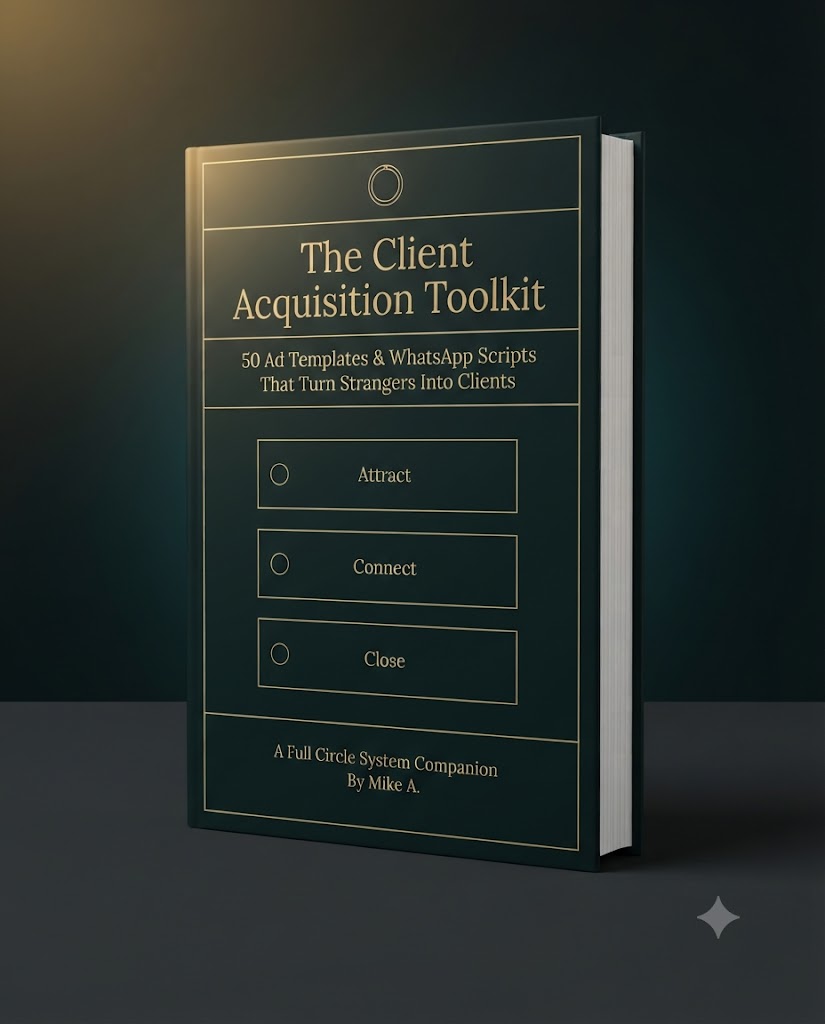
The Client Acquisition Toolkit
50 ad templates plus a full WhatsApp closing script library, built for the Nigerian and diaspora market. Copy, personalize, send — this alone can get you a client conversation within 48 hours.
Value: ₦24,900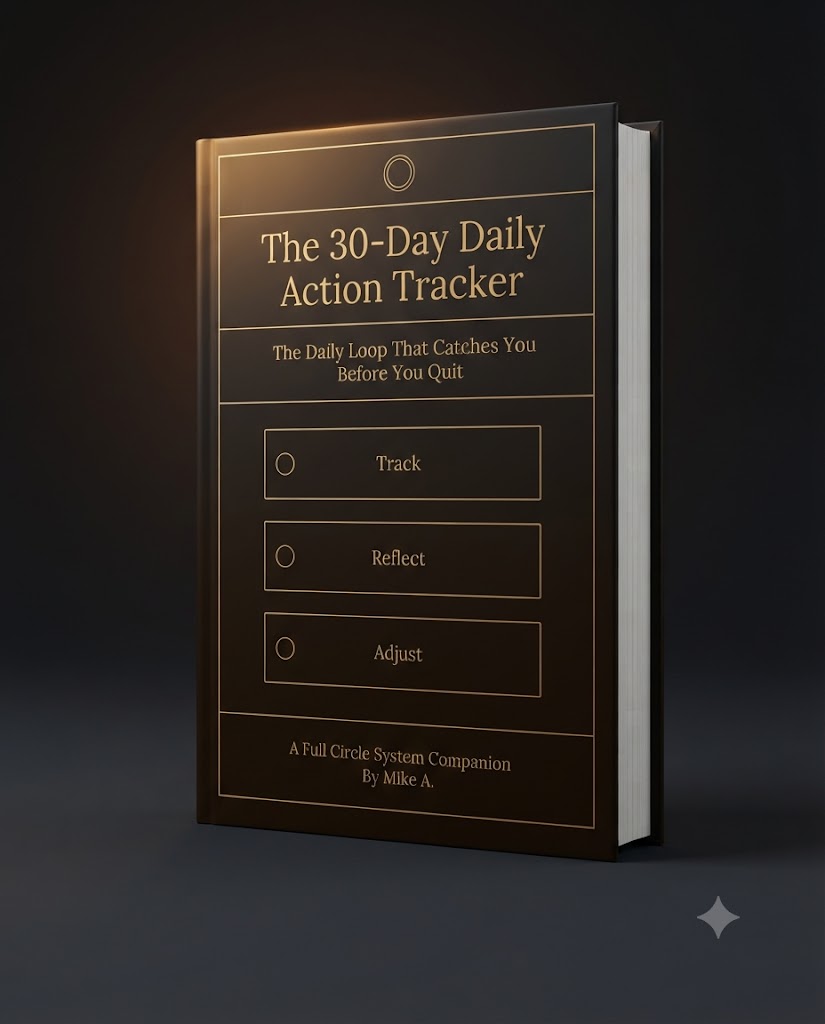
The 30-Day Daily Action Tracker
Printable and digital. Maps directly onto the Full Circle Protocol so you can spot the exact day your motivation dips — and respond before it becomes a quit.
Value: ₦5,000What You Get — and What You Pay
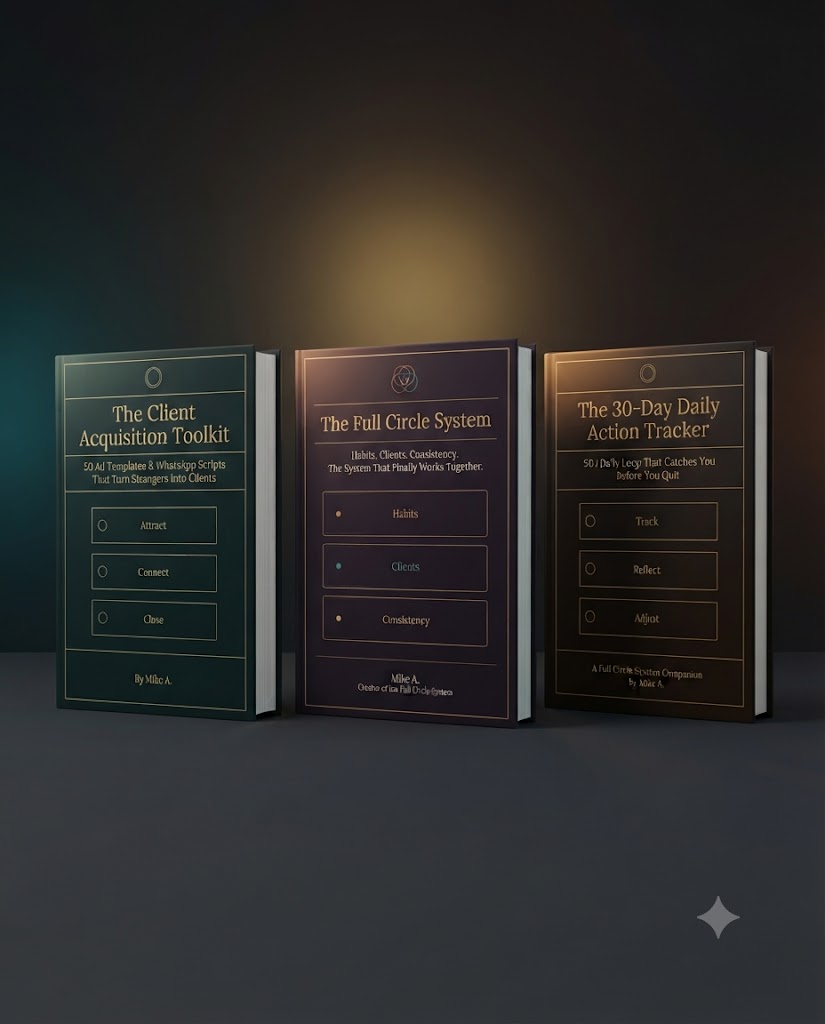
This is a founding-batch launch price for the first 50 people who join. Once that batch is filled, the price returns to ₦39,900.
The 30-Day "Prove It To Yourself" Guarantee
Go through the Diagnosis. Set up the tracker. Run the first week of the Acquisition Engine. If, after 30 days, you don't feel a genuine shift in clarity and momentum, send one email and every naira comes back — no forms, no back-and-forth. I built this because I lived every layer of the problem it solves.
Two Options From Here
Option 1: Close this page
The next idea comes. You build a habit plan again, or find another ads course, and fix one layer while the other two stay exactly where they were. Around Week 2 or 3, the familiar drop returns. Another grave, in a graveyard only you can see.
Option 2: Act right now
Thirty days from today, all three layers are running as one system — not three separate half-finished attempts. You've survived the dopamine drop for the first time with a plan already in hand. The income, small at first, has begun to arrive.
P.S. This comes with a full 30-day guarantee. Read it, run the first week, and if it doesn't move the needle, you get your money back. You risk nothing except the version of yourself that keeps solving one-third of the problem at a time.
P.P.S. The ₦14,900 founding-batch price is only for the first 50 people. Once that batch fills, it returns to ₦39,900. If the button above is still active, you're in time.
P.P.P.S. You are not your five graves, or your fifteen. You're the person about to run all three layers at once, for the first time. That's the only real difference between where you are and where you're trying to get to.
— Mike A.